Australia has not been able to reach its 10c Container Deposit Scheme targets... Until now!
So we're launching Australia's Largest Ever Social & Environmental Impact Experiment called Return for a Cause — a live, measured national test of behaviour change at scale.
Australia's container deposit scheme has plateaued at ~67% return rates. The 10c Recycling Games introduces a structured, measurable pathway to reach the legislated 85% target using proven behavioural incentives.
Australia's Container Deposit Schemes

Container Deposit Schemes were created for three clear reasons.
These are the government's own stated objectives — in order of priority.
Primary
Reduce beverage container litter
Beverage containers accounted for up to 44% of all litter by volume. The 10-cent deposit was the chosen mechanism to eliminate them from the environment.
Secondary
Increase container recycling rates
Divert eligible containers from landfill by incentivising consumers to return them into the recycling supply chain rather than discard them.
Tertiary
Support the circular economy
Return materials back into productive use — reducing reliance on virgin resources and building a closed-loop resource recovery system.
Reported National Average
~67%
Official scheme performance (includes kerbside MRF recovery). This is what governments claim. Yet 1 in 3 containers still isn't returned.
Unreturned Containers Annually
~4B
Based on approximately 12 billion containers sold nationally (source: annual reports / Boomerang Alliance / ABCL), at the current 67% return rate, approximately 4 billion eligible containers go unclaimed every year — representing ~$400M in deposits that remain unreturned to consumers.
Estimated Scheme-Only Returns — Based on our analysis of published annual reports, excluding kerbside MRF recovery
~59%
Based on our analysis of published annual reports, when kerbside MRF containers are excluded, the audited consumer return rate through the scheme (RVMs, depots, direct) is approximately 59%. This figure is the arithmetic mean of the eight state scheme-only return rates derived from each coordinator's published annual reports.
26%
The real distance to the 85% target. State coordinators are relying on MRF claims. The behavioural gap is not 18%. It's 26% of pure consumer non-participation.
How It Works
The Container Deposit Scheme
explained simply
At the time of purchase, you pay an extra 10 cents as a container deposit per eligible drink at the till. That 10 cents is held and ready to be refunded when you return the empty container. Most of the population don't know this — and IPART analysis indicates that scheme fees that beverage manufacturers are liable to pay are also passed through to consumers at the checkout, though industry disputes this finding.
Buy
You purchase a drink → +10c deposit added at the till
System Flow
Beverage manufacturer passes that 10c into the state coordinator
Return
You return the empty container to a depot or machine
Refund
You get your 10c back
You are getting your own 10 cents back
— not earning new money.
Beverage manufacturers are legally liable for scheme fees — and IPART evidence indicates these costs are passed through at the checkout (industry disputes this finding). Additionally, retailer margin increases were observed following scheme introduction. The true cost impact extends beyond the deposit itself.
Who Runs It
State Government
Sets the rules, targets, and legislation — but does not operate the scheme day-to-day. Compliance and reporting fall under state environment departments.
Scheme Coordinator
Manages the 10c deposit pool in each state — collecting from manufacturers, paying refunds at return points, and reporting scheme performance.
Beverage Manufacturers
Industry representatives hold positions on scheme coordinator boards. As entities liable for scheme fees, they have governance influence over scheme operations.
The Problem
The scheme has the money. The public sees less than half.
Australia's Container Deposit Scheme is collecting over $1.2B in consumer-paid deposits every year — and failing its legislated 85% return target every single year. The infrastructure exists. The refunds exist. But under current scheme arrangements, unclaimed consumer deposits can be applied toward scheme operational costs, which include beverage manufacturer fee offsets. The QLD Parliamentary Inquiry (March 2025) raised concerns about whether sufficient value is being directed toward public awareness and behaviour change initiatives. The behaviour gap remains the missing piece that needs dedicated funding.
4 billion containers.
To litter and landfill. Every year.
Of the 12 billion-plus eligible 10-cent beverage containers sold in Australia each year, around a third never come back — ending up as litter on beaches, in waterways, and in landfill. That's around 4,000,000,000 containers. The scheme was created to stop exactly this, and never has.




Containers lost to litter & landfill annually
~4,000,000,000
And this number grows every single year the scheme fails to hit 85%.
19×
Around Australia's entire coastline
Laid end-to-end along every beach, headland and harbour in the country — nineteen times over.
17×
Around the Earth
Enough to wrap the entire planet — oceans and all — seventeen times with nothing but discarded bottles and cans.
To the moon + 90% back
If stacked end-to-end into space
At 170mm per container, 4 billion containers reach the Moon — and most of the way home again.
2,686×
Covering the MCG playing surface
The MCG playing surface is 160m × 135m (21,600m²). Stack containers across it 2,686 times — or pile them 148m high, taller than a 40-storey building.
This is the scheme's own stated primary objective — reduce beverage container litter.
It was the first and most important reason governments legislated a 10-cent deposit. Every year the 85% target is missed, another 4 billion containers become environmental waste.
~0.0B
Eligible containers sold annually
~0%
National avg. return rate
0%
Legislated target — never achieved
0%
Gap between target and reality
The Return Rate You're Not Being Told About
Official Claimed Rate
~67%
18% gap to the 85% target
Includes containers processed through kerbside recycling by Material Recovery Facilities (MRFs) — even though the consumer threw them in their yellow bin and never received a refund.
Actual Consumer Return Rate
~59%
26% gap to the 85% target
The real rate when MRF kerbside containers are excluded. Under scheme rules, these containers may be counted toward scheme performance, which can affect manufacturer contribution fees — despite no refund ever being paid to the consumer.
What this means: The performance gap may be larger than publicly reported figures suggest. The 85% legislated target — framed as "almost within reach" — could be 30% away from where genuine consumer participation sits. Every MRF-counted container represents a deposit consumers paid but never reclaimed.
Why the behaviour gap persists — and who benefits from it
People don't understand the deposit
Most Australians don't realise they've already paid a deposit at the till. They're not 'earning' 10c — they're reclaiming their own money. This fundamental misunderstanding reduces the perceived value of returning.
There's almost no mass awareness
State coordinators run schemes efficiently, but national consumer education campaigns are limited. There's no consistent, engaging message that reaches everyday Australians where they are.
The 10c incentive has lost its pull
Cost of living pressures have changed priorities, but they haven't made 10c more meaningful. Without a compelling reason to change habits, most people simply don't bother — even when they intend to.
No social or community hook
Recycling is a solitary act with no visibility, no recognition, and no social reward. There's nothing that connects individual action to collective impact — and nothing that makes participation feel worthwhile beyond the coin.
Every state coordinator says the same thing: out-of-home is the gap they cannot close.
Across every Australian Container Deposit Scheme, the story is identical — infrastructure is mature, home returns are strong, but the containers consumed away from home are simply never coming back. Not because people don't care. Because 10c isn't worth the inconvenience of carrying a container until you find a refund point.
Cafés & Hospitality
Workplaces & Offices
Events & Festivals
Parks & Public Spaces
WA
WARRRL
Containers for Change
65.6%
of 85% target
Coordinator's stated barrier
Out-of-home consumption in hospitality, mining camps and events. Strategic Plan 2025–27 names it directly as the hardest remaining gap.
QLD
Container Exchange (COEX)
Containers for Change
67.1%
of 85% target
Coordinator's stated barrier
Public spaces and on-the-go consumption. Parliamentary inquiry confirmed the 10c incentive is insufficient to motivate return behaviour in commercial & recreation zones.
NSW
Exchange for Change
Return and Earn
68%
of 85% target
Coordinator's stated barrier
On-the-go consumption. Statutory review highlights that 'away-from-home' containers are the principal unrecovered stream, with infrastructure additions yielding diminishing returns.
SA
SA EPA
Container Deposit Scheme
75%
of 85% target
Coordinator's stated barrier
Even the scheme's longest-running performer cites workplaces, events and transit hubs as the stubborn remaining gap — the containers that simply never make it back.
VIC
VicReturn
CDS Vic
62%
of 85% target
Coordinator's stated barrier
Consumer awareness and out-of-home convenience. Behaviour change studies show consumers in dense urban environments discard on-the-go rather than carry containers to a refund point.
NT
NT EPA + private coordinators
NT Container Deposit Scheme
88%
of 85% target
Coordinator's stated barrier
Remote community access and out-of-home consumption at events and recreation facilities. High-volume consumption settings have no viable return pathway for participants.
Why 10c fails out of home — and why points don't.
The Inconvenience Barrier
Carrying a container while out and about is a friction-heavy behaviour. The only reward is 10c — and the perceived inconvenience of holding onto that container easily exceeds that value. Behaviourally, it feels like it costs you more than you get back.
10c
feels like it costs $10
The Opportunity Shift
When one container equals 10 points and you're competing for life-changing prize draws, the calculus flips entirely. You're no longer getting a measly 10c — you're investing in a win. The container becomes an active asset worth taking home, not a burden.
Points
are a game currency to win
The Result
Participation in hospitality, retail, workplaces and event spaces rises — not because the 10c refund changed, but because the meaning attached to the action changed. That is the behavioural gap the existing scheme cannot close on its own.
Same container.
Completely different behaviour.
The solution isn't just more infrastructure — it's prioritising behaviour change.
Unclaimed consumer deposits could fund awareness campaigns and return incentives. The QLD Parliamentary Inquiry highlighted that behaviour change initiatives need dedicated resourcing. Without this focus, the legislated 85% target will remain out of reach.
People thinkRefund = Extra Money
But you're just getting your own money back
86%
Support increasing the refund to 20c
But here's what they don't realise...
65%
Believe it would help with cost of living
The refund isn't income — it's your own money returned
69%
Say higher refund = more participation
The barrier isn't the amount. It's the behaviour.
People Think
Refund = extra money
Reality
You're getting your own money back
People Think
Higher refund = more benefit
Reality
You pay more at the till first
People Think
Participation = earning
Reality
Participation = reclaiming your deposit
Think of it like this
It's like a shopping trolley: you put in a coin to use it, and get the same coin back when you return it. You don't make money — you just get your deposit back. That's exactly how the refund works.
The Behavioural Gap
The scheme has structural shortcomings. But the real problem is how people understand it.
The Recycling Games fixes both — turning confusion into clarity and inaction into measurable impact. When people understand the scheme, participation becomes a no-brainer.
$2.5B
Generated. Only 36% returned to consumers.
The Queensland Parliamentary Inquiry exposed a structural gap between what the scheme collects and what it delivers. The 85% legislated target has never been met. The behaviour gap is the missing piece.
85%
Legislated target
Container recovery rate required by law — never once achieved by COEX since the scheme launched in 2018.
62.7%
Actual return rate
Return rate recorded in the first two quarters of 2024–25 — down from 67.4% the previous year. Moving in the wrong direction.
$2.5B
Revenue generated
Total scheme revenue since inception. Yet only 36% has been returned to Queenslanders as refunds (QLD Parliamentary Committee Chair Rob Molhoek, Oct 2025), and less than 2% went to charities.
10
CCC referrals
Allegations referred to the Crime and Corruption Commission covering conflicts of interest, unfair contracts, misleading conduct, and bullying.
The Solution
Australia's largest ever social and environmental impact experiment.
Make container returns fun and rewarding. Turn it into a game with prize pools and leaderboards funded by container returns.
The 10c Recycling Games is a national behavioural strategy layered on top of the existing CDS. It doesn't replace infrastructure — it fills the gap that infrastructure can't fill. Instead of returning containers for a few dollars, Australians return containers for a chance to win a share of hundreds of millions of dollars — funded entirely by the scheme's own unclaimed refunds and container returns themselves.
Containers
4
Returned
Points Earned
40
14Week ReturnStreak
That's the behaviour driver backed by better education. A genuinely compelling reason to act — every single week. And the prize pool? It's self-funded: built 10c at a time from real-time container refunds allocated to the prize pool and topped up with the unclaimed refunds the scheme coordinators hold.
Mass Awareness
A national campaign that reaches Australians where they are — on their phones, in their communities, through media. The Recycling Games makes the CDS visible, understood, and talked about at a scale no state coordinator has the mandate or budget to achieve alone.
Behavioural Education
We close the understanding gap. Every participant learns that the 10c is their deposit — money they've already paid. That reframe alone is transformative. When people understand the scheme, participation becomes a no-brainer.
Proven Incentive Mechanics
The centrepiece is a prize pool worth hundreds of millions of dollars annually — funded entirely by unclaimed refunds and container refunds in real-time. Variable rewards, weekly draws, and instant wins create the same compulsive participation loop that drives lotteries and gaming globally. Except here, the entry fee is recycling.
Works within the existing scheme
No new infrastructure. No policy changes. No disruption to state coordinators. At every existing return point, participants simply choose what to do with their refund.
Take the refund
Keep the 10c per container as usual — nothing changes.
Donate to a cause
Redirect your refund directly to a charity or community group.
Play the 10c Recycling Games
Convert refunds into points — spend them on draws, instant win games, and rewards.
The outcome
10c feels meaningless
A chance to win hundreds of millions
Confusion about deposits
You choose — it's your money
Solitary habit
National movement with weekly draws
The target
85%
National return rate — legislated, achievable, and measurable.
How It Works
Four steps. One simple idea.
Every container is worth 10 points.
No complex rules. Return containers at any existing return point — the same way you always have — and watch your points stack up in real time.
12B+
containers sold in Australia each year
Return Any Eligible Container
At any return point — RVM, depot, bag drop, at home or at work collection. Every container counts.
Every eligible 10c bottle or can you return is instantly converted into game currency. It doesn't matter where or how you return — depot, reverse vending machine, bag drop, at home or at work collection. If it's eligible for a 10c refund, it earns you points.
Earn 10 Points Per Container
1 container = 10 points. 10 containers = 100 points. Simple.
Every container is worth exactly 10 points — your in-game currency. So 10 containers = 100 points. 100 containers = 1,000 points. Points never expire. They stack up across every return session, building your balance and your leaderboard ranking.
100s of $M
in prizes — self-funded by the scheme
Spend Points — Your Way
Enter draws, play instant win games, or donate. You decide.
Points are your currency — spend them however you want. Enter weekly mega draws for life-changing cash prizes. Play instant win games for smaller, immediate wins. Or donate the value of your points to a registered charity or community group. The choice is always yours.
Weekly Mega Draws
Spend points for entries into major prize draws
Instant Win Games
Spend points to play for immediate cash prizes
Donate to a Cause
Redirect the value of your points to charity
Live
national leaderboards — updated in real time
Climb the Leaderboards
Individual rankings, team boards, schools, clubs & community groups.
Your points automatically feed into live leaderboards — so every container you return moves you up. Compete individually against other players across Australia, or join a team and dominate the group rankings.
Form teams with anyone
Individual
Sarah M.
Northside Scouts
48,200pts
Jake T.
Solo Player
41,750pts
Priya K.
Green Giants FC
38,900pts
Tom R.
St Mary's Primary
29,400pts
You?
Join a team!
???
Team Board
Northside Scouts
Community Group · 38 members
284,000pts
St Mary's Primary
School · 62 members
241,500pts
Green Giants FC
Sports Club · 24 members
198,700pts
Collins Family
Family · 7 members
112,400pts
Your Team?
Join or create a team!
???



Every can or bottle on the ground?
That's 10 points someone left behind.
The Games don't just incentivise returning your own containers — they make you see every piece of litter differently.
Experience It Now
Try the beverage container return simulator
National Prize Pool — Live
Funded by container returns and unclaimed refunds. Select Play the Recycling Games below to convert your containers into points — and compete for your chance to win.
Containers In
5,200,001,061
through the Games
Annual Prize Pool
$520,000,106
and growing
Weekly Prize Pool
$10,000,000
every single week
Step 1 — Choose what to do with your refund *
Step 2 — Return your containers(RVM shown for simulation — all return methods are eligible)
Cans Deposited
0/10
Refund Value
$0.00
Available to Return (10)— click or drag to deposit
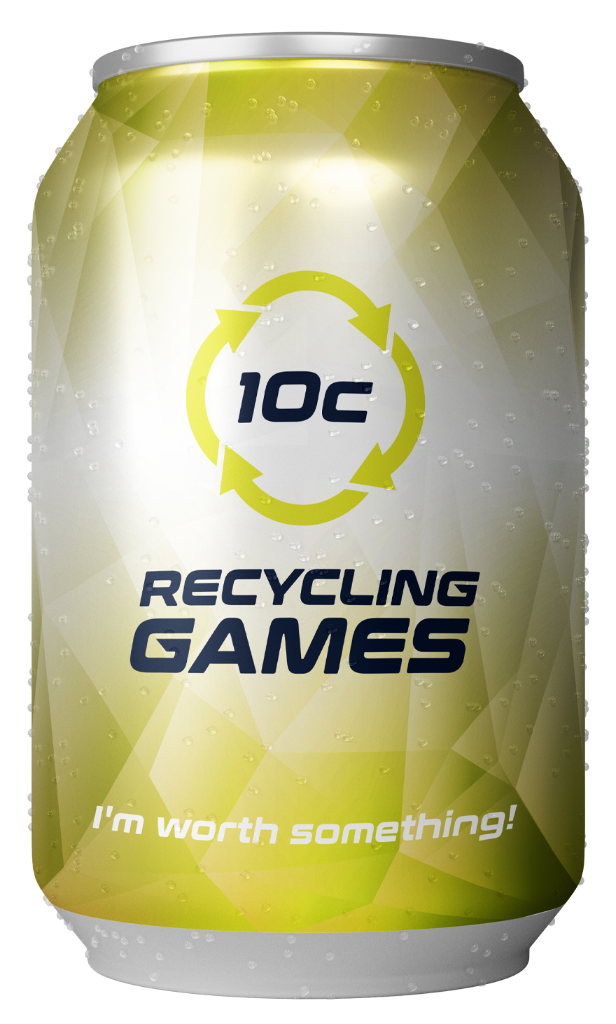
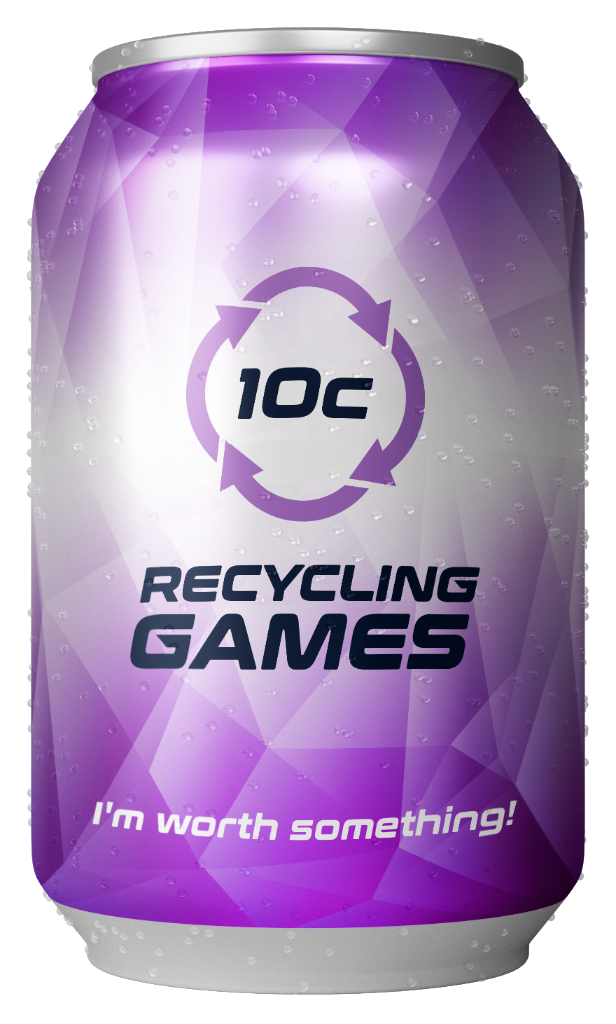
Reverse Vending Machine
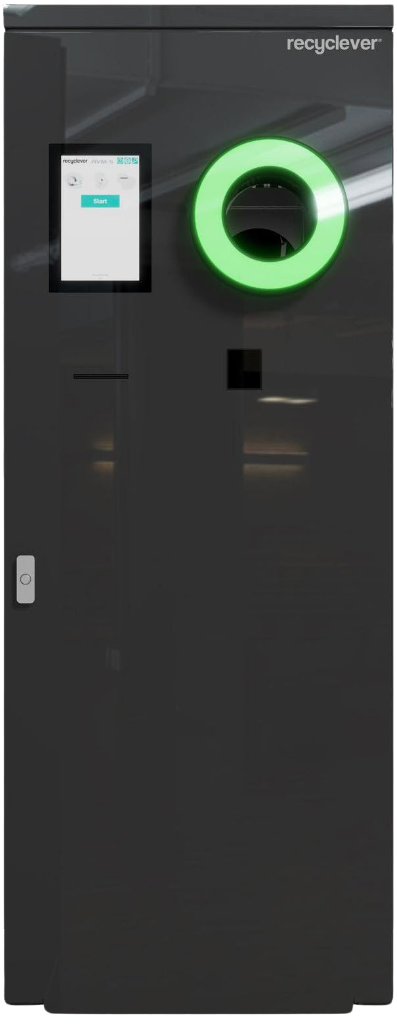
Click to deposit all
The Full Player Journey
10 Points Per Container. Convert containers into points and play to win.
From joining to returning containers, earning points, entering draws and choosing your cause.
Want to understand why this works?
We've mapped the exact neurochemical systems that make the 10c Recycling Games one of the most powerful drivers of human behaviour ever designed into an environmental program.
Containers are just the beginning.
The 10c Recycling Games is our entry point into a much larger vision — one that turns every recoverable resource into fuel for the incentivised behavioural economy.
Mining the Modern World's Riches from our homes
E-waste, batteries, rubber, metals, plastics, textiles — billions in recoverable value hiding in plain sight in cupboards, draws, sheds etc. We're extracting it, returning it, and funding the future with it.
Discover Urban Mining
Designing a Waste-Free Future with circularity
Moving beyond 'take-make-dispose' to a regenerative system where every resource that can be recovered, is. The circular economy isn't just an environmental framework — it's an economic one.
Explore CircularityOne ecosystem. One self-sustaining loop. Every resource finds its way home.
$400M
sitting unclaimed. every year.
Every year, over $400 million in container refunds go unclaimed by Australian consumers. This is not government revenue. This is not scheme money. This is consumer money — paid at the point of purchase — being quietly misdirected into manufacturer cost offsets instead of the behaviour change it was designed to create.
$400M
In unclaimed refunds annually
Sitting idle or subsidising manufacturers
7 of 8
Schemes below the 85% target
The infrastructure exists. The behaviour hasn't changed.
~4B
Containers not returned each year
Each one is a missed refund. Each one is money in the pool.
Every Australian CDS coordinator has attempted to solve the return rate gap with infrastructure, campaigns, and refund point expansion. None have broken through 85%. The evidence is unambiguous: the barrier is behavioural, not logistical. The pool exists to fix this. It is not being used.
The impact experimentneeds $300M.
From the unclaimed refund pool. Consumer money. Already inside the system. Directed to the only solution that will actually work.
Phase One
The EOI
Australians answer questions about their recycling habits, their understanding of the Container Deposit Scheme, and opt in to play the 10c Recycling Games — becoming part of Australia's largest ever social and environmental impact experiment.
Survey: recycling habits & scheme awareness

Opt in to the 10c Recycling Games
Real behaviour change measured at population level
Free entry — open to every Australian, national from day one
$50M
National prize pool
The incentive that drives mass participation.
$50M
National advertising
TV, digital, social — recruiting players across every state.
Phase Two
Full Rollout
Full national scale — technology, prize pools, advertising, operations. The self-sustaining flywheel that changes Australian recycling behaviour permanently to exceed return targets and reward participation.
$100M
National prize pool at launch
Mega Draw events, weekly and monthly draws, and instant win games — front-loaded from day one.
$80M
Mass awareness campaign
Sustained national advertising — TV, digital, social, community — recruiting players across all states.
$20M
Platform, operations & buffer
World-class platform, coordinator integrations, regulatory compliance, and contingency reserve.
Total Requirement
$300M
From the Unclaimed Refund Pool. Consumer money. Already inside the system.
⚠ Direct Question — State Coordinators
Are you going to back Australia's Largest Ever Social & Environmental Impact Experiment and unlock this funding?
If not, the public and the media deserve a statement explaining why — why the very organisations whose statutory duty is to save these beverage containers from litter and landfill refuse to back the only mechanism that will actually work.
For Government & CDS Coordinators
Funding and delivery of the impact experiment
How the funding flows, how the behaviour change works, and why this model is scalable, credible and aligned with public interest outcomes.
How this looks to
the Australian public.
When this launches, Australians will see it on every screen. The story is simple, credible, and overdue. This is what national coverage looks like.
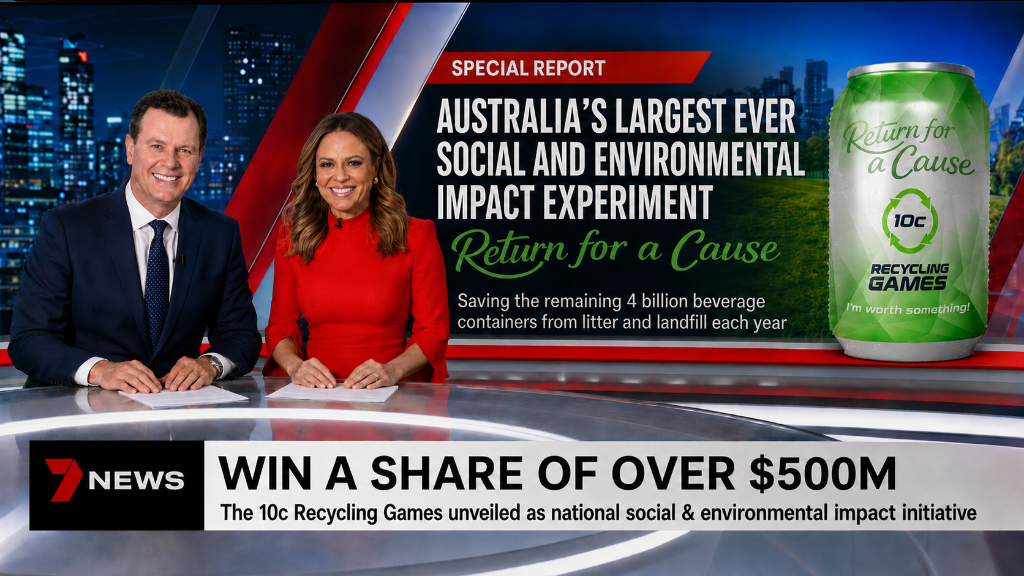
* Image generated using AI for illustrative purposes only. Not an actual broadcast or endorsement by any network.
1 July 2026 · 9:00 AM AWST — National media submissions open
Official Press Release
Expression of Interest Phase — For Immediate Distribution
FOR IMMEDIATE RELEASE
Australia's Largest Ever Social & Environmental Impact Experiment Called Return for a Cause Is Set to Launch with Over $500 Million in Cash and Prizes
More than 12 billion eligible beverage containers are sold across Australia every year, generating over $1.2 billion in consumer-paid container deposits.
Yet approximately 4 billion beverage containers worth more than $400 million still end up as litter and landfill annually.
Return for a Cause powers the 10c Recycling Games, a national initiative designed to unlock the participation, awareness and behavioural change needed to recover the billions of containers the current system continues to miss.
The initiative is seeking $300 million from Australia's annual pool of unclaimed consumer-paid refunds to launch Australia's Largest Ever Social & Environmental Impact Experiment.
Australians will continue to have the same choices they have today: claim their refund, donate it to a cause, or use its equivalent value to participate in a national game ecosystem featuring cash prizes, instant wins, individual challenges, team competitions and community impact.
Powered by Australia's container return economy and the more than $1.2 billion in annual deposit value already flowing through the nation's container deposit schemes, the initiative is projected to create more than $500 million in annual cash and prize opportunities while helping recover the remaining 4 billion beverage containers entering litter and landfill every year.
Beyond participation, the initiative establishes a substantial philanthropic commitment. Over $200 million in dedicated funding will support social and environmental impact causes — embedded directly into the recycling journey. Every returned container becomes a tool for community enrichment, ensuring the benefits of the circular economy reach those who need it most.
This initiative represents a pivotal shift toward a truly Circular Economy. Through Urban Mining — incentivised resource recovery from urban areas — we are transforming waste streams like e-waste, batteries, rubber, metals, and plastics into valuable resources. By applying large-scale incentives and behavioural science, we are fundamentally changing how Australia views waste: from disposal to recovery, keeping precious materials in circulation to build a brighter, sustainable future.
The objective is simple.
Turn one of Australia's biggest waste problems into Australia's biggest participation movement — with a projected 10 million participants nationwide.
The countdown to launch has begun.
Media Contact
Matty Gee
10c@therecyclinggames.com.au
The Incentive
What people actually play for.
Every eligible container returned redirects a 10c refund into a national prize pool — funded entirely by the Container Deposit Scheme. No purchase. No gambling. Just recycling.
$520,000,169
Funded entirely by container deposit refunds — growing with every return.
$10,000,000
Paid out across draws and instant win games.
How The Games Work
We sit on top of the scheme.
Nothing changes below us.
No new machines. No policy changes. No new infrastructure. We're a behavioural gaming layer that plugs into the existing Container Deposit Scheme via API.
Return your containers
Use any existing CDS return point — RVM, depot, bag drop, at-home collection, or at-work collection. Nothing changes for you here. The infrastructure already exists.
Select the 10c Recycling Games
At the return point, choose an option — just like selecting a charity or taking a payout to your own account. Our member number is already registered with each state coordinator.
Our systems talk and the coordinator pays us
The state coordinator processes your return and pays the refund value to our registered account. Our app talks to theirs via API — fully automated so we know how to reward you.
The game layer activates
Your return earns points to play instant win games and enter weekly and monthly draws. Your returns also trigger leaderboard movement and cause funding — all in real time. Purely a behavioural layer on top of the scheme. No new machines. No new infrastructure.
Win prizes. Move the national counter.
Every container returned contributes to the national tally, your state leaderboard, and prize draws — while funding causes you care about.
10 containers = 100 points
The full journey — every mechanic explained.
Fully optional · No change to your existing return behaviour
Costs are rising.
Giving capacity is falling.
Traditional fundraising relies on donations at the exact moment households have less to give. Demand for support is increasing. The system designed to fund it is under pressure.
The Shift in Model
- Relies on donations and ticket sales
- Harder to sustain when household budgets tighten
- Participation drops as financial pressure rises
- Organisations work harder for less
- Turns everyday container returns into funding
- Brands pay for attention — we redirect that value
- Scales with participation, not generosity
- No extra cost — no reliance on donations
The Outcome — At a Time When It's Needed Most
The philanthropy engine
Funded by behaviour, not donations. A direct link between participation and impact at an unprecedented scale.
Current Model
Traditional Giving
~$0M
~4.5% of refund economy directed to charity
4.5% utilisation
With Recycling Games
Behaviour-Funded Model
$0M+
Scaled model — annually to social & environmental causes
65% utilisation
The Philosophy
"Consumer behaviour generates revenue. Revenue funds social and environmental impact."
Maximum impact.
Zero disruption.
Nine proven advantages across the entire CDS ecosystem.
Increased return rates
Drive measurable uplift toward 85% target
Reduced landfill + litter
Divert billions of containers from waste streams
Higher CDS efficiency
More value extracted from existing infrastructure
No infrastructure cost
Operates entirely within current CDS framework
No policy disruption
Additive layer — does not alter existing legislation
Scalable nationally
Designed for deployment across all states and territories
Unlocks new audiences
Reaches demographics the scheme can't currently engage
Existing operations unchanged
Families, kids & organisations collect the refund as per normal
More registered participants
Scheme coordinators get more registered participants in their member database
Proven Model
Every benefit delivers measurable outcomes.
No trade-offs. No compromises. Just better results across the board.
Clear. Simple. Measurable.
A proven implementation pathway — from EOI to national deployment.
Phase One Funding & Final Preparations
Secure $100M
From the unclaimed refund pool
Recruit players nationally
Launch EOI
National Expression of Interest
Validate at population scale
Measure
Participation + behaviour uplift
Phase Two Rollout & Launch
Deploy
Full national program with $200M funding
Ready to Launch
Four phases. One clear pathway to national impact.
Each phase builds on the last — measurable, scalable, and fully funded from the unclaimed pool.
Our commitment
Give us 12 months.
We'll reach the target.
We're that confident.
Get In Touch
We'd love to hear from you
Drop us a message and we'll get back to you as soon as possible.
Keep going.
Dive deeper into the mechanics. There's more to discover.


Important Legal Disclaimer
Please read and acknowledge these terms before continuing.